Motor Protection Circuit Breaker (MPCB): Practical Selection Guide Based on SSPD CGV2 Series
(SSPD Official Website · Q&A Style)
Electric motors are the core of industrial systems—but they are also highly sensitive to overload, short circuit, and phase failure. Choosing the right Motor Protection Circuit Breaker (MPCB) is critical to motor safety, system reliability, and long-term operating cost.
This guide is written from the manufacturer’s perspective, using the SSPD CGV2 series MPCB as a real technical reference, so panel builders, OEMs, and distributors can make correct, project-safe selections.
Q1: What is an MPCB and why is it essential for motor protection?

A Motor Protection Circuit Breaker (MPCB) is a protection device specifically designed for motor circuits.
Unlike standard MCBs or MCCBs, an MPCB is engineered to handle:
-
High motor starting (inrush) current
-
Long-term thermal overload
-
Short-circuit faults
-
Phase loss in three-phase systems
The SSPD CGV2 series MPCB integrates:
-
Adjustable thermal overload protection
-
Fixed magnetic short-circuit protection
-
Manual STOP / START / RESET operation
This makes it a compact and reliable motor starter protection solution.
Q2: Why is CGV2 MPCB better than using a normal MCB for motors?
Motors typically draw 6–8 times rated current during startup.
A normal MCB often trips incorrectly during this phase.
CGV2 MPCB advantages:
-
Thermal setting matched to motor rated current
-
Magnetic tripping set at Id = 20 × In (±20%)
-
Stable startup without nuisance tripping
-
Reliable protection under real industrial conditions
👉 CGV2 is designed to allow motor starting, but stop real faults.
Q3: What current ranges does SSPD CGV2 MPCB cover?
The CGV2 series provides a wide and continuous current coverage, suitable for most industrial motors.
| Model | Current Setting Range (A) |
|---|---|
| ME01 | 0.01 – 0.16 |
| ME02 | 0.16 – 0.25 |
| ME03 | 0.25 – 0.4 |
| ME04 | 0.4 – 0.63 |
| ME05 | 0.63 – 1 |
| ME06 | 1 – 1.6 |
| ME07 | 1.6 – 2.5 |
| ME08 | 2.5 – 4 |
| ME10 | 4 – 6.3 |
| ME14 | 6 – 10 |
| ME16 | 9 – 14 |
| ME20 | 13 – 18 |
| ME21 | 17 – 23 |
| ME22 | 20 – 25 |
| ME32 | 24 – 32 |
This allows precise matching to motor nameplate current, reducing overheating and extending motor life.
Q4: What motor power ratings can CGV2 protect?

Based on AC-3 duty, 50/60Hz, 3-phase motors, CGV2 supports a wide power range:
At 400 / 415V
-
From 0.06 kW (ME02)
-
Up to 15 kW (ME32)
At 500V
-
From 0.37 kW
-
Up to 18.5 kW
At 690V
-
From 0.37 kW
-
Up to 22 kW
This makes CGV2 suitable for:
-
Pumps & compressors
-
Conveyors & mixers
-
HVAC and ventilation systems
-
Industrial machinery and OEM motor panels
Q5: How does the magnetic protection of CGV2 work?
The magnetic tripping current of CGV2 MPCB is fixed at:
Id = 20 × In (±20%)
Examples:
-
ME07 (1.6–2.5A) → Magnetic trip ≈ 33.5A
-
ME14 (6–10A) → Magnetic trip ≈ 138A
-
ME32 (24–32A) → Magnetic trip ≈ 416A
This design ensures:
-
Instant reaction to short circuits
-
No false trips during motor start
-
Protection for cables and downstream devices
Q6: How is CGV2 MPCB used in a motor starter?
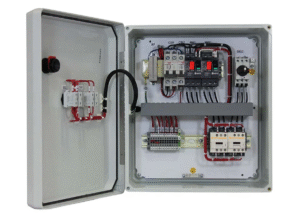
A standard motor starter configuration:
-
CGV2 MPCB: protection + manual isolation
-
AC Contactor: frequent switching
-
Together they form a safe and compact motor control unit
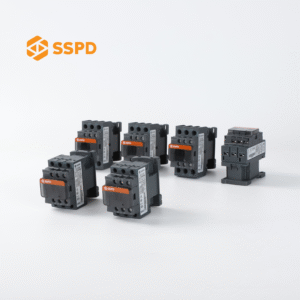
SSPD designs CGV2 MPCB to be mechanically compatible with mainstream contactors, making panel assembly easier for OEM customers.
Q7: What makes SSPD CGV2 MPCB suitable for projects and long-term supply?
From a factory and exporter viewpoint, CGV2 focuses on consistency and reliability:
✔ Accurate thermal calibration
✔ Stable magnetic tripping
✔ Good heat dissipation
✔ Consistent batch quality
✔ OEM logo & labeling support
✔ Suitable for Middle East, Africa & Southeast Asia environments
SSPD positions CGV2 not as a “cheap alternative”, but as a project-oriented motor protection solution.
Q8: Can CGV2 MPCB replace international brands?
In many industrial and commercial applications, yes—with correct selection.
SSPD does not promote blind 1:1 replacement. Instead, we provide:
-
Clear current and power matching
-
Application-based recommendations
-
Stable configurations for repeat orders
This approach reduces project risk and improves long-term cooperation.
Final Conclusion
If your application involves:
-
Three-phase motors
-
Frequent start/stop
-
Medium to heavy-duty operation
-
High downtime cost
👉 SSPD CGV2 Motor Protection Circuit Breaker is the right choice.
For motor selection support, panel matching, or OEM cooperation, SSPD is ready to support your project from design to delivery.